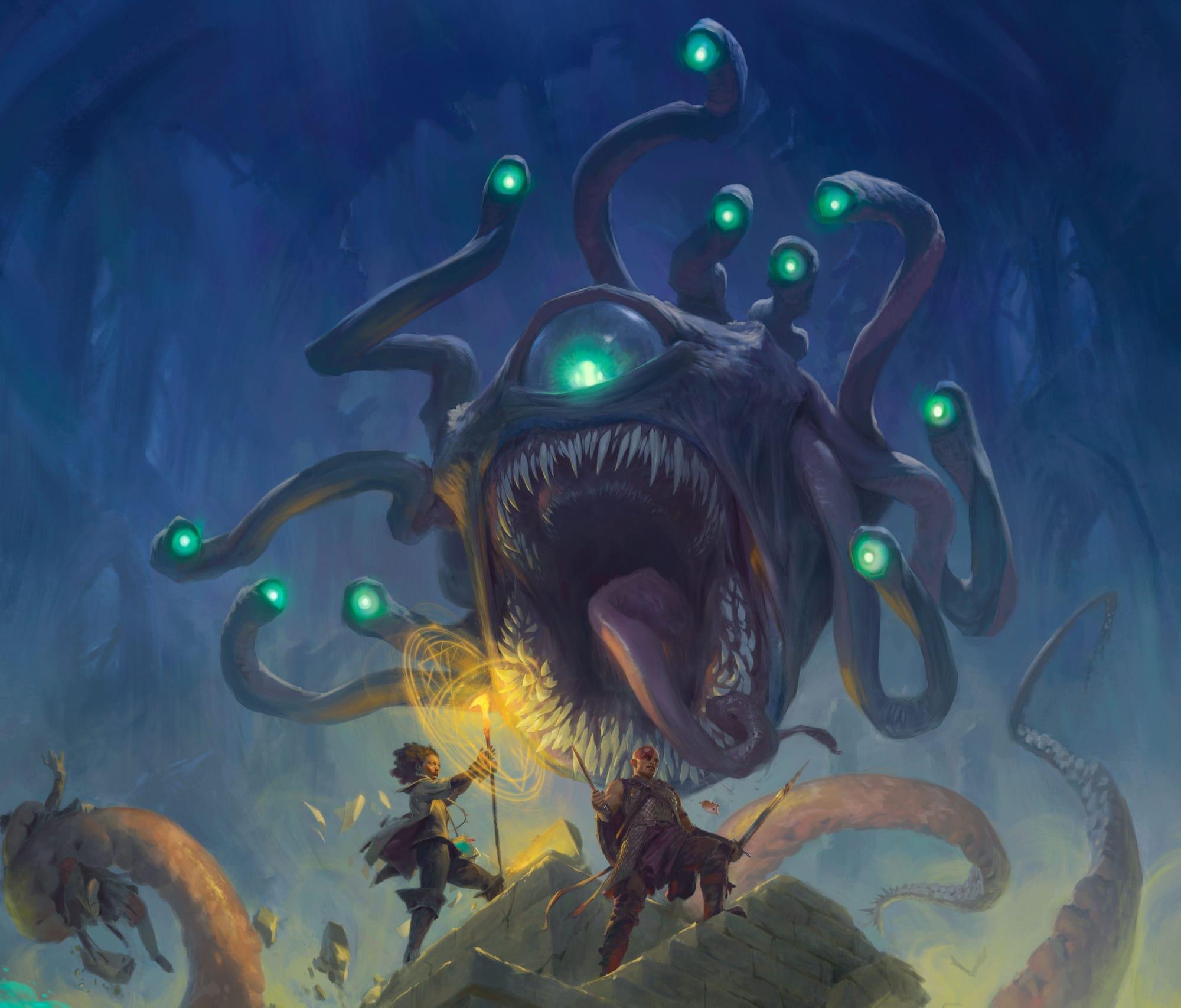
Besides dragons, Beholders are probably the most iconic monster in Dungeons & Dragons history. They also hold a very interesting place in dnd lore, with there being tons of information written about them that covers everything from their origins to their digestive system. If you’re keen on including a Beholder in your D&D campaign - or homebrew worldbuilding - then it's time you learnt more about them.
When and how were Beholders created?
The Beholder - or eye tyrant - was created by Terry Kuntz, brother to D&D co-author Rob Kuntz, and first appeared in Dungeons and Dragons way back during the tabletop RPG’s first edition - featuring in the 1975 supplementary book Greyhawke.
The drawing of the Beholder found on the front cover of Greyhawke was created by Tom Wham. The Beholder has since been depicted in a variety of different ways over the years, from the 1983 Dungeons & Dragons cartoon version, to the image by Kieran Yanner that’s featured in the 5th Edition Monster Manual.
What is a Beholder?
Beholders are classed as Aberrations in dnd, which is basically a category designated for some of the strangest creatures in the tabletop roleplaying game world. Aberrations are creatures that have no place being in the Prime Material Plane (which is where most of the standard D&D species like elves and dwarves live), due to their disturbing features and origins from distant places.
Initially, Beholders were a scholarly species, travelling from their own home in the Far Realms to the many other planes, in order to record their observations and findings, before reporting back to their Hive Mother. However - and somewhat understandably - folks began to grow afraid of these intimidating creatures, eventually cursing the entire Beholder species with a form of amnesia. Since then, Beholders have entirely forgotten their original purpose and became a species of lawful evil meglomaniacs.

What do Beholders look like?
Beholders are large, round creatures that levitate over the ground. Easily the most distinctive features of the Beholder is the singular eyeball situated in the middle of its body, alongside the 10 eye stalks protruding from the top.
The Beholder design has changed somewhat over the years, starting out as a heavily armoured creature with segmented eye stalks, before eventually becoming its more recognisable version: with a scaled body and fleshy, tentacle-like eye stalks. Nevertheless, Beholders have always remained exceptionally hardy monsters, mainly due to the stonelike material their skins are made from, which grant them a very high armour class.
What makes a Beholder so dangerous?
Approaching a Beholder should not be taken lightly, no matter the intent.
Beholders are incredibly paranoid and xenophobic monsters, namely due to their constant suspicion of other Beholders, and the fact that many of them have a mind made up of two separate entities: both of whom are often at odds with each other. Additionally, Beholders are blindingly intelligent and very charismatic (surprisingly enough, for an enormous eye blob), qualities that, when combined with their usually evil natures, make them unbelievably cunning and manipulative.
Perhaps the most dangerous aspect of a Beholder - besides their mind - are their eye stalks, which they’re able to channel magic through. Ten in total, these eye stalks are the primary way that Beholders attack, with each one sending out a different ray of energy against an opponent. These eye rays include:
- A charm ray - which does psychic damage and applies the ‘charmed’ status
- A paralyzing ray - which inflicts the ‘paralyzed’ status
- A fear ray - which does psychic damage and applies the ‘frightened’ status
- A slowing ray - which does necrotic damage and slows you to half speed
- A enervation ray - which does poison damage and inflicts the ‘poisoned’ status
- A telekinetic ray - which enables the Beholder to move and restrain enemies
- A sleep ray - which sends the victim into unconsciousness
- A petrification ray - which first restrains and then petrifies enemies
- A disintegration ray - which does force damage and completely disintegrates anyone who drops to 0 hit points
- A death ray - which does necrotic damage and instantly kills anyone who drops to 0 hit points, without saving throws
These are all bad, though some are certainly worse than others, and can be used by a Beholder as many as seven times over the course of a single round - thanks to actions like the Beholder’s multi-attack and their ability to use legendary actions during other characters’ turns. Additionally, due to the Beholder’s aforementioned high intelligence and charisma ability scores, it’s also rather difficult to save against these rays.

On top of all this, the Beholder’s central eye has the passive ability of an anti-magic field, which prevents anyone from casting spells, performing actions with magical effects or using magic items within a 150 ft antimagic cone in front of the Beholder.
Overall, unless you’ve ever fancied turning into stone or dust, Beholders are generally better avoided or grovelled at. However, they are incredibly arrogant, so it might be worth appealing to their sense of self-superiority or paranoia, if you want to talk your way out of a nasty situation.
How should I use a Beholder in my D&D campaign?
Beholders are extremely dangerous monsters and should only be faced by a party of adventurers who are either a high enough level or stupid enough to try. The Dungeons & Dragons challenge rating for Beholders is 13, meaning that it probably should only be fought by a group of characters who are at least level 9, and even then it’ll be a hard fight.
Beholders are usually found in the Underdark - the subterranean domain of the Drow - often far from other beings, especially other Beholders (whom they despise). These are extremely territorial creatures, who will attack anyone they deem to be enough of a threat (or a tasty enough meal). Some Beholders do get more involved with civilization and can be encountered in more populated areas, usually in positions of authority and power.
If a dungeon master wants to inject their dnd campaign with a sense of great danger or strangeness, then they could feature a Beholder - possibly as a mastermind behind some great plot or a genius hermit who’s fiercely protective of their domain. Remember, your players can choose not to engage with the Beholder, especially if they’re too wary of the consequences of fighting one. You could also have your Beholder not be as aggressive, instead choosing to manipulate or use your players for their own gain.

Other weird facts about Beholders
- There are several different types of Beholder variants in Dungeons & Dragons besides the standard one, including multiple undead variants and the near-immortal Elder Orb
- There is an entire family of offshoots from Beholders known as Beholderkin, which are not quite full Beholders, and consist of the bloodsucking Death Kiss and lesser mini-Beholders like the Gazer and the Gauth.
- A Beholders' dreams’ can bring another Beholder into being, including copies of themselves.
- Flower petals are one of the Beholders’ favourite things to eat.
- Multiple thieves guilds in Faerun have been run by Beholders, including the famous Xanathar (who you can find on the cover of the dnd sourcebook Xanathar’s Guide to Everything) - leader of Xanathar’s Thieves Guild - and Grandmaster of Waterdeep’s Shadow Thieves, Xabash.
- There are - a few - non-evil Beholders in the world of Faerun, including Large Luigi: who is the proprietor and bartender of the Happy Beholder tavern.