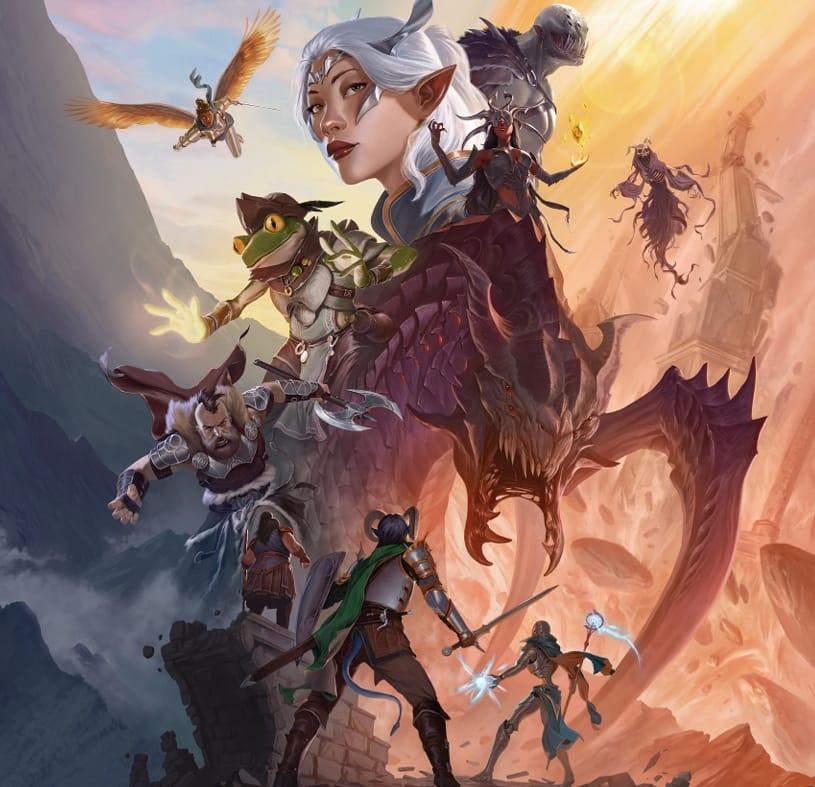
Daggerheart is the latest tabletop roleplaying game created by lead game designer Spenser Starke and published by the Critical Role-adjacent studio, Darrington Press. Inspired by Dungeons & Dragons, Lord of the Rings and Dragon Age: Inquisition, Daggerheart is a narrative-driven fantasy TTRPG for three to five players all about collaborative storytelling, character arcs and heroism.
If you want to start running Daggerheart yourself, there are various pieces you’ll want to put in place beforehand. From gathering the right materials to preparing your players, here’s everything you’ll need to do to plan your very first Daggerheart RPG campaign.
Get everything you and your players need
Once you and your players have decided to play Daggerheart, you’ll need to get your hands on a copy of the core rulebook. Players and game masters will both need access to the Daggerheart Core Rulebook, as it contains vital information for creating characters, learning how to play and - most importantly for you - planning a Daggerheart campaign.

Alongside copies of the core rulebook, you’ll want to get copies of the various Daggerheart cards: which players use to create, level up and use their characters. You’ll also need these as references for the players’ characters and any NPC (non-player characters) you make.
On top of this, you’ll want a set of polyhedral dice and two d12 dice, preferably of different colours, the same goes for your players. Consider also some classic dnd note taking tools - either a pen and paper or a digital option - and a method of creating and referencing your campaign planning resources, such as a notebook or virtual tools such as Legendkeeper and Nexus.
Familiarise yourself with the rules
You won’t need to be a master of roleplaying to begin running a Daggerheart campaign, especially as it’s designed to be less complicated than popular tabletop RPGs like d&d 5e, but it’s a good idea to brush up on the rules whilst planning your campaign. Obviously, you should read the Daggerheart Core Rulebook, but for quick reference:
This TTRPG runs on an original system that primarily uses d12 dice, alongside some additional polyhedral dice. Whenever players choose to perform an action as their character, as the GM, you can ask them to roll to decide the outcome of this intended action. Players will always roll two d12, then add any additional dice and modifiers depending on the trait they’re rolling with. You decide the difficulty level number that players will need to meet to get their intended outcome, with a 5 being very easy and a 30 being near impossible.
Daggerheart’s central gameplay mechanic is the Hope and Fear duality dice, represented by the two d12 that players roll when trying to overcome your obstacles. The success or failure of a player’s roll is heavily augmented by whichever die rolled the highest number. A success with the Hope die enables players to achieve their intended goal and gain Hope - a currency they can use to activate certain abilities - whereas failure with Hope, results in an unintended outcome but still has the player gaining Hope. By contrast, success with a Fear die enables you, the GM, to add some complications to the outcome, whereas failure on a Fear die results in a complete mess on the player’s part - with major complications.

Whenever a player’s Fear die rolls the higher number, you gain some Fear that you can then use to perform various moves to further challenge your players. Fear can be spent immediately or later on, and can be used to increase the danger and threat present in certain scenarios - from the arrival of a new adversary to the player characters taking stress (or damage).
The pacing and direction of a Daggerheart session is largely driven by these action rolls and their outcomes, with this being a tabletop RPG that’s heavily reliant on improvisation and collaboration. However, there is still plenty you can do to plan for your Daggerheart RPG campaign.
Help your players make their characters
If your players are also new to Daggerheart, they’ll need some guidance when making their characters, you’ll also want to take note of their choices and incorporate them into your Daggerheart RPG campaign.
Character creation in Daggerheart sees players choosing a class, subclass, class features, ancestry, community, character trait valuest, additional character information, starting equipment, background, experiences, domain cards and connections. Whilst some choices are pretty self-explanatory - such as class and ancestry - others might require some input from you: like creating character traits and choosing their experiences. This is then input into a Daggerheart character sheet, which will depend on whichever class the player choice.
All of these elements can be utilized for your Daggerheart campaign plans and, in-fact, should be a valuable source of inspiration for plot hooks, non-player characters, key moments and the overarching story for your campaign: to give you some starting points to provide compelling narratives that your players can get invested in.

Make a map for your world
Making your map sees you sitting down with your players and deciding which locations to include and placing them across a blank map canvas together.
You can get a blank map from the appendix in the Daggerheart Core Rulebook and either copy and print it out, or use a digital tool like Legendkeeper to create a virtual version or even your own original map outline.
Then share this with your players - either in-person or online - collectively decide on a name for your region and add the various locations from your player characters’ backgrounds, before going through a list of locations (either from the Daggerheart Core Rulebook or of your own creation) and add them to the map until you’re all happy with the finished product.
Choose or create a campaign frame
A campaign frame will provide a general structure for your story: from its initial hooks to its twists and turns.
There are several pre-made campaign frames found in the Daggerheart Core Rulebook, if you’d rather move forward with running your campaign. Alternatively, you can create your own original campaign frame, using the various lore elements of Daggerheart - found in the Core Rulebook - your players’ characters and whatever inspirations you find yourself drawn to.
A Daggerheart campaign frame should be made up of a collection of resources you can draw upon whilst running your RPG sessions, which players can then respond to and drive the story forward with during the game. Daggerheart is largely a collaborative and improvisation-heavy TTRPG, so it’s best not to overplan and make your campaign frame too linear.

Instead, create some initial story hooks for your players to follow - consider the motivations for your player characters and NPCs, why would they want to explore these storylines? Add some NPCs for players to interact with, perhaps some key moments you can sprinkle in where they fit and, of course, some adversaries for players to clash with and some battle maps to fight them in (both of which you can create yourself or find examples of in the Daggerheart Core Rulebook).
Your campaign frame will evolve and grow as you and your players create a Daggerheart story together, be sure to make notes either during or after each session, as these can provide you with new inspirations and opportunities to build on the narrative. The most important thing is to not box your or your players in and let their roleplay, as well as the results of the hope and fear dice, guide the story.
Run a session zero
Before diving into the first session of your campaign proper, you’ll want to run a session zero with your player group. A session zero provides an opportunity for you and your players to become familiar with the rules and the feel of Daggerheart. You can also use a session zero for group character creation and map creation.
A session zero should be a low stakes affair, with action and plot being put firmly on the back burner in favour of player interaction. Create a scenario for your players’ characters to either meet for the first time, or otherwise interact with one another in a way that allows players to get used to roleplaying with one another, and establish their characters’ relationships.
Be sure to use your session zero to establish the general tone of your campaign and introduce important worldbuilding elements that your players’ characters will be familiar with. You should also be introducing safety tools such as lines and veils (which you can read more about in the Daggerheart Core Rulebook), and providing opportunities for your players to share any topics or themes they might be uncomfortable with.