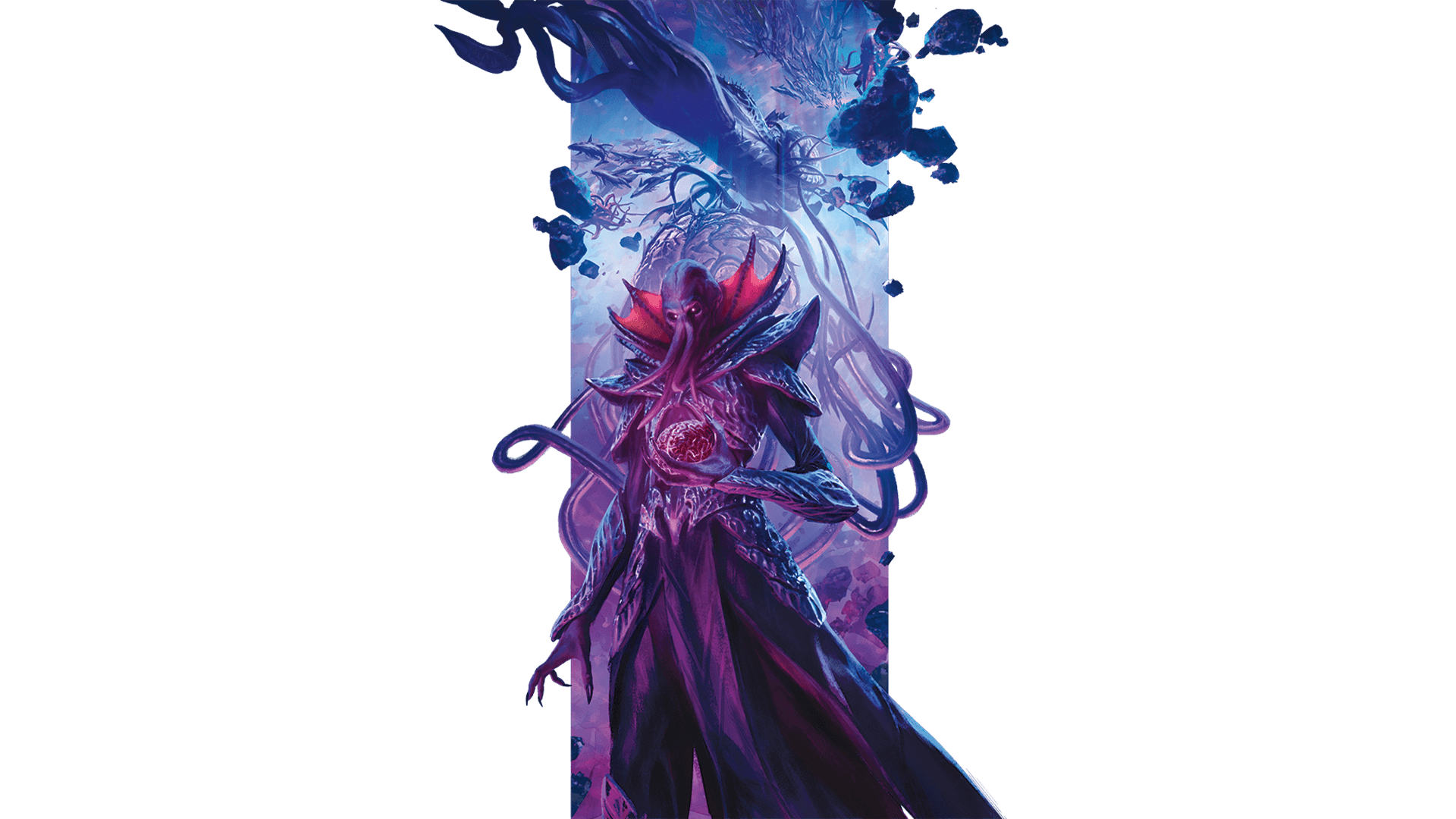
Mind Flayers are a classic Dungeons & Dragons monster that’s gotten a lot of attention in recent years, having featured (albeit, in an unconventional manner) as a major antagonist in the popular Netflix television series, Stranger Things. Award-winning D&D video game Baldur’s Gate 3 also heavily featured Mind Flayers, with the main plot revolving around the threat of the player’s character and their allies turning into one.
But what is a Mind Flayer? If you’re not already in the know - or if you want to learn more about these horrifying creatures - then you can stick around and find out more than you ever wanted to know about Mind Flayers: where they come from, how they’re created, and why they’re some of the most dangerous creatures in 5th Edition.
What is a Mind Flayer?
Mind Flayers - otherwise known as Illithids - are mauve-coloured cephalopod-like creatures with a handful of tentacles dangling from the bottom of their faces, a beak-like mouth within the tentacles, and a humanoid-esque body.
All Mind Flayers are physically interconnected with the other Mind Flayers within their own colony. Illithids primarily feed on brains for sustenance, using their psionic abilities to lure other humanoids close enough to use their tentacles to restrain their heads, before cracking into their skulls with their beaks and consuming the brain.

When were Mind Flayers first introduced into Dungeons & Dragons?
Mind Flayers were some of the earliest long-running monsters introduced into the world of Dungeons & Dragons. They made their first appearance in The Strategic Review #1, a newsletter sent out by TSR (the company that owned D&D before Wizards of the Coast bought the property) in 1975, which outlined a creature that clearly took inspiration from Cthulhu, and utilized psionic abilities.
The Illithid were finally included in an official DnD supplement with 1975’s Blackmoor via an illustration, before gameplay mechanics around Mind Flayers were added within the Eldritch Wizardry supplement released soon afterwards.
Mind Flayers were eventually included in the D&D First Edition Monster Manual (1977) sourcebook, as well as starring in the 1998 supplement The Illithiad (incredible name), which featured a lot of the core lore around the monsters. From Dungeons & Dragons 3E onwards, players have been able to play as an Illithid in various different classes and forms.
How are Mind Flayers created?
Mind Flayers are not created through reproduction, but rather through a process called Ceremorphosis. This is where an Illithid implants a tadpole into the brain of a humanoid (often through the eye), which then makes its home within the victim’s skull. The tadpole then grows, until it’s large enough to consume the victim’s brain. Once the tadpole has eaten the brain, it becomes a sentient being who turns the host’s body into an Illithid, making the transformation complete.
Where do Mind Flayers come from?
Mind Flayers, like all aberrations, come from a place known as The Far Realm - a dimension of madness, where terrible creatures are birthed. Eventually, Mind Flayers migrated to The Astral Plane, a space-like dimension that the Illithids made their home.
The Illithids formed their own empire, enslaving the native species of the Gith and using them to perform manual labor for them. Mind Flayers became the dominant species of The Astral Plane, using their multiverse-travelling ships - Nautiloids - to travel to different planes to find more humanoid victims to feed on, enthrall, and study.

However, the Gith were eventually able to rebel against their Mind Flayer masters, breaking themselves free from enslavement and destroying the Illithid empire within a year. The surviving Illithids fled to the Material Plan (where humans, elves, dwarves etc… live), going into hiding from the roaming bands of Githyanki and Githzerai who continue to hunt for them.
Mind Flayers are now scattered across the world of the Forgotten Realms, lurking in the Underdark and working in service of The Grand Design: or rebuilding the mighty Illithid empire by killing all Gith and putting all other humanoids under their thrall.
How does Mind Flayer society work?
Illithids exist within a hierarchical society, with an Elder Brain ruling over a colony of Mind Flayers. The Elder Brain is connected to all the Mind Flayers within its colony, capable of seeing through their eyes and gathering all the experience, knowledge, and skills collected by the members of its colony.
The Elder Brain maintains its dominance over all Illithids that remain within a 5 mile radius, with some Mind Flayers granted the opportunity to leave the colony on special missions - as long as they remain loyal to the Elder Brain.
When an Illithid grows old, infirm, or injured, the Elder Brain consumes their physical body, with the Mind Flayer’s memories and knowledge being stored within the Elder Brain, which works as a sort of form of immortality.
Sometimes, an Illithid grows psionically powerful enough to become an Ulitharid. These Mind Flayers are able to feed their psionic power, until they leave the colony with a group of other Illithids to form their own colony. Once they’ve found somewhere suitable, the Ulithaird transforms into an Elder Brain themselves.

If an Illithid strays far enough from the control of the Elder Brain, it can become a renegade Mind Flayer and operate separately from a colony. Renegade Mind Flayers may leave to form their own colonies. Alternatively, renegade Mind Flayers are capable of seeing other humanoids as equals and worthy of respect, meaning that they can find allies and potentially even work towards positive goals (as long as they have a healthy supply of food).
What other types of Mind Flayers are there?
Besides the Elder Brain and standard Illithids, there are other types of Mind Flayers in the world of Dungeons and Dragons.
Alhoon: Alhoons - or Illithilich - are Illithids who choose to focus on arcana, as well as cultivating their psionic powers. Doing this allows them to become powerful undead liches, whose goals revolve around their own survival and acquiring more knowledge and power for themselves. As such, Alhoons are pariahs in Illithid society, as they no longer live to serve the Elder Brain.
Vampiric Illithids: There is no clear origin for Vampiric Mind Flayers. These Illithids are feral and unintelligent creatures whose only desire is to consume blood and brains. Other Illithids greatly fear Vampiric Illithids, and destroy any they come across.
Mind Witness: Perhaps one of the most disturbing off-shoots of Mind Flayer, Mind Witnesses are Beholders who have been implanted with an Illithid tadpole - turning them into a sort of amplifier of psionic energy.
Urophion: Urophions are Ropers - grotesque underground-dwelling tentacle creatures - who have been infected with a Mind Flayer tadpole, turning them into effective guards for Illithid colonies.

How dangerous are Mind Flayers?
Mind Flayers are lawful evil medium aberrations, who are primarily dangerous because of their psychic abilities, even though they’re physically weak.
Illithids will generally attack other humanoids who aren’t Mind Flayers or aren’t from their colony, especially if they deem them a threat to their colony or view them as potential food or thalls.
Mind Flayers have a decent armor class rating (15), with a hit point total of around 100. Whilst their intelligence, wisdom, and charisma scores are high, their strength, dexterity, and constitution are lower in comparison.
Illithids have a natural resistance to psychic damage, a passive perception of 16, and the ability to use telepathy on other creatures within 120 feet. Mind Flayers also have advantage on saving throws against spells and other magical effects.
The main attacks from Illithids revolve around their psychic abilities and their tentacles.
Their tentacle attack deals 22 damage (4d8+4), and if the target is of a medium size or smaller then they’re grappled, requiring a DC14 to escape. Once grappled by a Mind Flayer, a victim might have to perform a DC 15 saving throw to avoid taking full damage from an extract brain attack (55 or 10d10). Regardless of whether they succeed or fail, should a victim’s hit point total fall to 0 from this attack, then the Mind Flayer will extract their brain and kill them.
An Illithid’s other main attack is mind blast, which targets all creatures within a 60-foot cone and requires an intelligence saving throw of DC 15, otherwise victims will take the full 31 (or 6d8+4) psychic damage and are stunned until the end of the Mind Flayer’s next turn.
Otherwise, Mind Flayers are capable of casting a small collection of spells using their Intelligence modifier. These spells include Detect Thoughts (which they can cast at will), as well as Dominant Monster and Plane Shift (both of which can be cast once a day, with Illithids only able to cast Plane Shift on themselves).

How dangerous is an Elder Brain?
Whilst coming across a few Mind Flayers is potentially dangerous for an adventuring party, encountering an Elder Brain could spell the end of a campaign.
Elder Brains are large aberrations whose psychic abilities pose a serious threat to even more experienced groups of players. Though their armor rating is relatively low (10), their beefy hit point total (210), incredibly high intelligence score (21), and charisma score (24) - combined with their psychic powers - make fighting an Elder Brain very challenging.
As they don’t have eyes, ears, or mouths, Elder Brains use other means of seeing, hearing, and speaking. Elder Brains can sense intelligent creatures within 5 miles, including which direction and distance they’re in, unless they’re using spells like Mind Blank and Non-detection. Additionally, Elder Brains can also use telepathy to initiate conversation with up to 10 creatures at one, enabling them to all hear and engage with the same conversation.
Additionally, if an Elder Brain can sense an incapacitated creature, they can choose to establish a psychic link with them. This enables the Elder Brain to sense and feel everything the victim experiences, as well as know all their thoughts and feelings. The victim will need to break free from the connection with a DC18 CHA saving throw, or leave the five mile radius controlled by the Elder Brain.
An Elder Brain has three separate chances to automatically save on any saving throws per day, even if they initially fail their roll - thanks to their legendary resistances. Elder Brains also have an advantage on saving throws against magical spells or abilities, due to their magic resistance.
Through its legendary actions, Elder Brains are able to perform powerful actions on other creatures’ turns every round, namely based on whether they have a psychic link with someone. Through a psychic link, Elder Brains can cause their victim to break concentration on a spell, deal psychic damage to their target - and all enemies within a 30 ft radius - and sever their psychic link on command, which causes the released victim to gain disadvantage on all ability checks, attack rolls, and saving throws until the end of their next turn. Just like Mind Flayers, Elder Brains can use Mind Blast.
Elder Brains can also cast spells using their intelligence score, including Detect Thoughts and Levitate at will, as well as Modify Memories up to three times a day, and Dominate Monster and Plane Shift once a day (and only on themselves).
Should magic or mind fail, Elder Brains are able to use their four tentacles to grapple their enemies, dealing 1d8+5 psychic damage to them every turn that they’re grappled.